Available as live instructor-led sessions either online or on-site, these Autonomous Vehicles (AVs) training courses utilize interactive, hands-on exercises to demonstrate how cutting-edge technologies and algorithms can be applied to develop, optimize, and deploy autonomous driving systems.
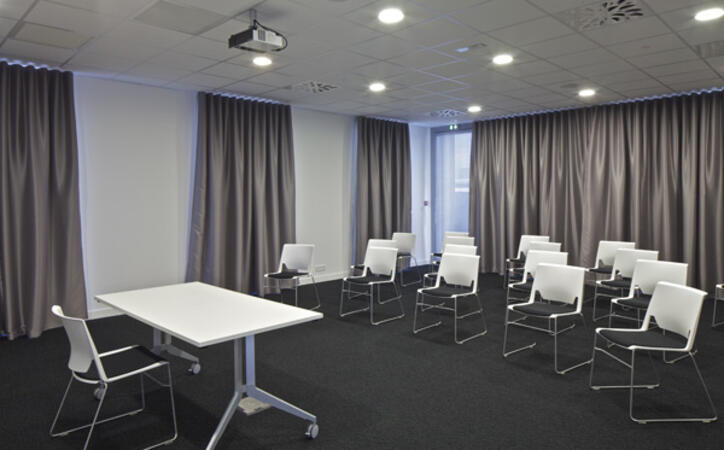
AVs training is offered in two formats: "online live training" (also known as "remote live training") and "onsite live training". Online sessions are conducted interactively via a remote desktop solution. Onsite training can be delivered directly at your premises in Lille or held at NobleProg’s corporate training facilities in Lille.
NobleProg -- Your Local Training Provider
Lille, Gare Flandres
NobleProg Lille, 21 Avenue le Corbusier, Lille, france, 59800
In front of Flandres TGV Train Station
From Lille train stations
From Lille-Flandres: the address is essentially right next to the station — about 1–3 minutes on foot.
From Lille-Europe: walk toward Lille-Flandres along Avenue Le Corbusier. It is roughly 5–10 minutes on foot.
So you don't need a bus or metro if you're arriving by train.
If you're coming by bus
The nearest bus stops to Avenue Le Corbusier include Lion d'Or and Jacquet. Several local lines serve the area, including 13, 86, L5 and L91.
This instructor-led, live training in Lille (online or onsite) is aimed at beginner-level professionals who wish to explore the ethical dilemmas and legal frameworks surrounding autonomous vehicles.
By the end of this training, participants will be able to:
Understand the ethical implications of AI-driven decision-making in autonomous vehicles.
Analyze global legal frameworks and policies regulating self-driving cars.
Examine liability and accountability in the event of autonomous vehicle accidents.
Evaluate the balance between innovation and public safety in autonomous driving laws.
Discuss real-world case studies involving ethical dilemmas and legal disputes.
This instructor-led, live training in Lille (online or onsite) is aimed at beginner-level professionals and enthusiasts who wish to understand the fundamental concepts, technologies, and applications of autonomous vehicles.
By the end of this training, participants will be able to:
Understand the key components and working principles of autonomous vehicles.
Explore the role of AI, sensors, and real-time data processing in self-driving systems.
Analyze different levels of vehicle autonomy and their real-world applications.
Examine the ethical, legal, and regulatory aspects of autonomous mobility.
Gain hands-on exposure to autonomous vehicle simulations.
This instructor-led, live training in Lille (online or onsite) is aimed at intermediate-level network engineers and automotive IoT developers who wish to understand and implement V2X communication technologies for autonomous vehicles.
By the end of this training, participants will be able to:
Understand the fundamental concepts of V2X communication.
Analyze V2V, V2I, V2P, and V2N communication models.
Implement V2X protocols such as DSRC and C-V2X.
Develop simulations for connected vehicle environments.
Address cybersecurity and privacy challenges in V2X networks.
This instructor-led, live training in Lille (online or onsite) is designed for intermediate-level engineers, automotive professionals, and IoT specialists who want to understand the role of sensors in self-driving cars, covering LiDAR, radar, cameras, and sensor fusion techniques.
By the end of this training, participants will be able to:
Understand the different types of sensors used in autonomous vehicles.
Analyze sensor data for real-time vehicle perception and decision-making.
Implement sensor fusion techniques to improve vehicle accuracy and safety.
Optimize sensor placement and calibration for enhanced autonomous driving performance.
This instructor-led, live training in Lille (online or onsite) is aimed at advanced-level safety engineers and automotive safety professionals who wish to develop comprehensive safety strategies for autonomous vehicles, including hazard analysis, functional safety assessments, and compliance with international standards.
By the end of this training, participants will be able to:
Identify and assess safety risks associated with autonomous driving systems.
Conduct hazard analysis and risk assessment using industry standards.
Implement safety validation and verification methods for AV systems.
Apply functional safety standards, such as ISO 26262 and SOTIF.
Develop risk mitigation strategies for AV safety challenges.
This instructor-led, live training in Lille (online or onsite) is aimed at advanced-level sensor fusion specialists and AI engineers who wish to develop multi-sensor fusion algorithms and optimize real-time navigation in autonomous systems.
By the end of this training, participants will be able to:
Understand the fundamentals and challenges of multi-sensor data fusion.
Implement sensor fusion algorithms for real-time autonomous navigation.
Integrate data from LiDAR, cameras, and RADAR for perception enhancement.
Analyze and evaluate fusion system performance under various conditions.
Develop practical solutions for sensor noise reduction and data alignment.
This instructor-led, live training in Lille (online or onsite) is aimed at intermediate-level AI developers and computer vision engineers who wish to build robust vision systems for autonomous driving applications.
By the end of this training, participants will be able to:
Understand the fundamental concepts of computer vision in autonomous vehicles.
Implement algorithms for object detection, lane detection, and semantic segmentation.
Integrate vision systems with other autonomous vehicle subsystems.
Apply deep learning techniques for advanced perception tasks.
Evaluate the performance of computer vision models in real-world scenarios.
This instructor-led, live training in Lille (available online or on-site) is designed for senior robotics engineers and AI researchers looking to implement sophisticated path planning algorithms that elevate the performance of autonomous vehicles.
Upon completing this training, participants will be equipped to:
Grasp the underlying theoretical principles of advanced path planning algorithms.
Deploy algorithms such as RRT*, A*, and D* to achieve real-time navigation capabilities.
Refine path planning processes to effectively manage obstacle avoidance and dynamic environmental changes.
Fuse path planning algorithms with sensor inputs to improve navigational accuracy.
Assess the efficacy of different algorithmic approaches within practical, real-world contexts.
This instructor-led, live training in Lille (online or onsite) is aimed at advanced-level data scientists, AI specialists, and automotive AI developers who wish to build, train, and optimize AI models for autonomous driving applications.
By the end of this training, participants will be able to:
Understand the fundamentals of AI and deep learning in the context of autonomous vehicles.
Implement computer vision techniques for real-time object detection and lane following.
Utilize reinforcement learning for decision-making in self-driving systems.
Integrate sensor fusion techniques for better perception and navigation.
Build deep learning models to predict and analyze driving scenarios.
Online Autonomous Driving training in Lille, Autonomous Vehicles training courses in Lille, Weekend AVs (Autonomous Vehicles) courses in Lille, Evening AVs (Autonomous Vehicles) training in Lille, Autonomous Vehicles instructor-led in Lille, Self-Driving Cars classes in Lille, Autonomous Vehicles one on one training in Lille, Weekend Autonomous Cars training in Lille, Evening Autonomous Vehicles (AVs) courses in Lille, AVs (Autonomous Vehicles) trainer in Lille, AVs boot camp in Lille, Online Self-Driving Cars training in Lille, Autonomous Driving private courses in Lille, Autonomous Vehicles on-site in Lille, Self-Driving Cars instructor in Lille, Self-Driving Cars instructor-led in Lille, Autonomous Cars coaching in Lille