Online or onsite, instructor-led live Computer Vision training courses demonstrate through interactive discussion and hands-on practice the basics of Computer Vision as participants step through the creation of simple Computer Vision apps.
Computer Vision training is available as "online live training" or "onsite live training". Online live training (aka "remote live training") is carried out by way of an interactive, remote desktop. Nantes onsite live Computer Vision trainings can be carried out locally on customer premises or in NobleProg corporate training centers.
NobleProg -- Your Local Training Provider
Nantes, Zenith
NobleProg Nantes, 4 rue Edith Piaf, Saint-Herblain, france, 44821
In the Parc d'Ar Mor zone, near the Zénith.
Car : from the ring road, Porte de Chézine Exit> Boulevard du Zenith > Esplanade Georges Brassens (restaurants) > Rue Edith Piaf on the right. From the N444 road (Nantes > Lorient), Exit #1 > boulevard Marcel Paul > Rue Edith Piaf at the right.
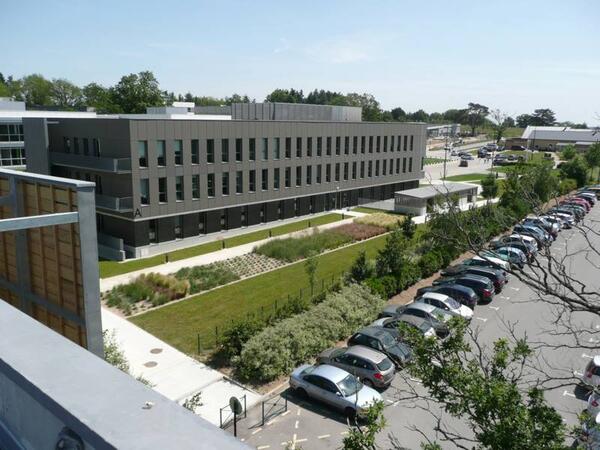
Parking Zénith P1 (free). Once parked, you can recognize the building: it's one of the tree bulding with zinc frontage.
Bicycle: free indoor parking
Public transport :
Tramway R1, Schoelcher station + 10 mn by foot through commercial center Atlantis
Tramway R1, François Mitterrand stop + bus 50, stop at Saulzaie station or bus 71, stop at the Zénith station
Tramway R3, Marcel Paul station + bus 50, Saulzaie station
Chronobus C6, Hermeland station+ bus 71, Zénith station
Bus : lignes 50 (Saulzaie station) or 71 (Zénith station)

This instructor-led, live training in Nantes (online or onsite) is designed for intermediate to advanced computer vision engineers, AI developers, and IoT professionals who want to implement and optimize computer vision models for real-time processing on edge devices.
Upon completing this training, participants will be able to:
Grasp the fundamentals of Edge AI and its applications in computer vision.
Deploy optimized deep learning models on edge devices for real-time image and video analysis.
Utilize frameworks such as TensorFlow Lite, OpenVINO, and NVIDIA Jetson SDK for model deployment.
Optimize AI models for performance, power efficiency, and low-latency inference.
This instructor-led, live training in Nantes (online or onsite) is aimed at advanced-level professionals who wish to deepen their understanding of computer vision and explore TensorFlow's capabilities for developing sophisticated vision models using Google Colab.
By the end of this training, participants will be able to:
Build and train convolutional neural networks (CNNs) using TensorFlow.
Leverage Google Colab for scalable and efficient cloud-based model development.
Implement image preprocessing techniques for computer vision tasks.
Deploy computer vision models for real-world applications.
Use transfer learning to enhance the performance of CNN models.
Visualize and interpret the results of image classification models.
The CANN SDK (Compute Architecture for Neural Networks) offers robust deployment and optimization capabilities for real-time AI applications in computer vision and natural language processing, particularly on Huawei Ascend hardware.
This instructor-led training, available both online and onsite, targets intermediate-level AI professionals seeking to build, deploy, and optimize vision and language models using the CANN SDK for production environments.
Upon completion of this training, participants will be able to:
Deploy and optimize CV and NLP models using CANN and AscendCL.
Leverage CANN tools to convert models and integrate them into active pipelines.
Enhance inference performance for tasks such as detection, classification, and sentiment analysis.
Construct real-time CV/NLP pipelines suitable for edge or cloud-based deployment scenarios.
Course Format
Interactive lectures and live demonstrations.
Practical labs focused on model deployment and performance profiling.
Live pipeline design utilizing real-world CV and NLP use cases.
Customization Options
For a customized version of this course, please reach out to us to arrange your training.
This instructor-led, live training in Nantes (online or onsite) is aimed at intermediate-level AI developers and computer vision engineers who wish to build robust vision systems for autonomous driving applications.
By the end of this training, participants will be able to:
Understand the fundamental concepts of computer vision in autonomous vehicles.
Implement algorithms for object detection, lane detection, and semantic segmentation.
Integrate vision systems with other autonomous vehicle subsystems.
Apply deep learning techniques for advanced perception tasks.
Evaluate the performance of computer vision models in real-world scenarios.
This instructor-led, live training session (available online or onsite) is designed for entry-level law enforcement professionals aiming to shift from manual facial sketching to utilizing AI tools for developing facial recognition systems.
By the conclusion of this training, participants will be able to:
Understand the core concepts of Artificial Intelligence and Machine Learning.
Learn the fundamentals of digital image processing and how it applies to facial recognition.
Develop competencies in using AI tools and frameworks to build facial recognition models.
Gain practical experience in creating, training, and testing facial recognition systems.
Comprehend the ethical considerations and best practices associated with facial recognition technology.
This instructor-led, live training in Nantes (online or onsite) is aimed at beginner-level to intermediate-level researchers and laboratory professionals who wish to process and analyze images related to histological tissues, blood cells, algae, and other biological samples.
By the end of this training, participants will be able to:
Navigate the Fiji interface and utilize ImageJ’s core functions.
Preprocess and enhance scientific images for better analysis.
Analyze images quantitatively, including cell counting and area measurement.
Automate repetitive tasks using macros and plugins.
Customize workflows for specific image analysis needs in biological research.
This instructor-led, live training in Nantes (online or onsite) is aimed at intermediate-level professionals who wish to use Vision Builder AI to design, implement, and optimize automated inspection systems for SMT (Surface-Mount Technology) processes.
By the end of this training, participants will be able to:
Set up and configure automated inspections using Vision Builder AI.
Acquire and preprocess high-quality images for analysis.
Implement logic-based decisions for defect detection and process validation.
Generate inspection reports and optimize system performance.
This guided, live training delivered in Nantes (online or on-site) targets intermediate to advanced-level developers, researchers, and data scientists who want to learn how to implement real-time object detection using YOLOv7.
By the conclusion of this training, participants will be able to:
Understand the fundamental concepts of object detection.
Install and configure YOLOv7 for object detection tasks.
Train and test custom object detection models using YOLOv7.
Integrate YOLOv7 with other computer vision frameworks and tools.
Troubleshoot common issues related to YOLOv7 implementation.
Fiji is a powerful open-source image processing package that bundles ImageJ (a program designed for scientific multidimensional images) along with a comprehensive suite of plugins for scientific image analysis.
In this instructor-led, live training, participants will learn how to leverage the Fiji distribution and its underlying ImageJ program to create robust image analysis applications.
By the end of this training, participants will be able to:
Use Fiji's advanced programming features and software components to extend ImageJ capabilities
Stitch large 3D images from overlapping tiles
Automate the update of a Fiji installation on startup using the integrated update system
Select from a broad selection of scripting languages to build custom image analysis solutions
Utilize Fiji's powerful libraries, such as ImgLib, to process large bioimage datasets efficiently
Deploy applications and collaborate effectively with other scientists on similar projects
Format of the Course also allows for the evaluation of participants.
Interactive lecture and discussion
Extensive exercises and practical application
Hands-on implementation in a live-lab environment
Course Customization Options
To request a customized training for this course, please contact us to arrange.
This instructor-led, live training in Nantes (online or onsite) is aimed at software engineers who wish to program in Python with OpenCV 4 for deep learning.
By the end of this training, participants will be able to:
View, load, and classify images and videos using OpenCV 4.
Implement deep learning in OpenCV 4 with TensorFlow and Keras.
Run deep learning models and generate impactful reports from images and videos.
Computer Vision is a discipline focused on the automatic extraction, analysis, and comprehension of valuable insights from digital media. Python, a high-level programming language renowned for its clean syntax and readability, serves as the foundation for this course.
Through this instructor-led live training, participants will master the fundamentals of Computer Vision by developing a series of simple applications using Python.
Upon completion of this training, participants will be able to:
Grasp the core principles of Computer Vision
Utilize Python to execute Computer Vision tasks
Develop custom systems for face, object, and motion detection
Audience
Python programmers seeking to specialize in Computer Vision
Format of the course
A blend of lectures, discussions, exercises, and extensive hands-on practice
SimpleCV is an open-source framework—comprising a collection of libraries and software that you can leverage to develop vision applications. It enables you to work with images or video streams from webcams, Kinects, FireWire and IP cameras, or mobile phones. It helps you build software that allows your various technologies to not only see the world but also understand it.
Audience
This course is designed for engineers and developers looking to create computer vision applications using SimpleCV.
This instructor-led live training in Nantes (available online or onsite) is designed for backend developers and data scientists who wish to integrate pre-trained YOLO models into their enterprise applications and implement cost-effective components for object detection.
By the end of this training, participants will be able to:
Install and configure the necessary tools and libraries for object detection using YOLO.
Customize Python command-line applications that operate based on YOLO pre-trained models.
Implement the pre-trained YOLO model framework for various computer vision projects.
Convert existing datasets for object detection into the YOLO format.
Understand the fundamental concepts of the YOLO algorithm for computer vision and/or deep learning.
Online Computer Vision training in Nantes, Computer Vision training courses in Nantes, Weekend Computer Vision courses in Nantes, Evening Computer Vision training in Nantes, Computer Vision instructor-led in Nantes, Computer Vision instructor in Nantes, Weekend Computer Vision training in Nantes, Computer Vision boot camp in Nantes, Computer Vision one on one training in Nantes, Computer Vision classes in Nantes, Computer Vision instructor-led in Nantes, Computer Vision private courses in Nantes, Computer Vision coaching in Nantes, Evening Computer Vision courses in Nantes, Computer Vision trainer in Nantes, Computer Vision on-site in Nantes, Online Computer Vision training in Nantes