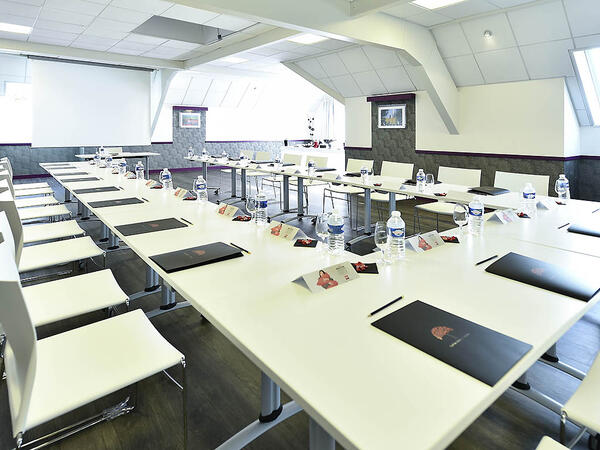
Whether delivered virtually or in person, our instructor-led Design Thinking workshops leverage practical case studies and hands-on exercises to help you master the five stages of Design Thinking. This approach enables teams to deeply understand the challenges faced by end-users of a product or service and formulate the most effective strategies to resolve them.
We offer Design Thinking training as "online live training" or "onsite live training". Online live training, also referred to as "remote live training", is conducted via an interactive remote desktop environment. Onsite live training can be hosted directly at client premises in Lyon or within NobleProg's corporate training centers in Lyon.
NobleProg -- Your Local Training Provider
Lyon, Swisslife Tower
NobleProg Lyon, 10 Place Charles Béraudier, Lyon, france, 69000
Located 200 meters far from the train station TGV, Swisslife Tower is today the most representative building of this quarter of Lyon. The Business Center offers you a perfect location for your training.
Gares TGV
100meters from Gare TGV Part-Dieu , porte du Rhône Exit
Aéroport
30 minutes from Lyon Saint Exupéry (Satolas)
Rhône Express from Saint Exupéry airport (Terminus Gare part-Dieu)
In this Lyon course, teams acquire Design Thinking skills to resolve issues through empathy, ideation, and prototyping. With a focus on the Empathize stage, you will bridge the gap between pain points and internal client needs, turning insights into actionable outcomes through dynamic collaborative activities.
This live training in Lyon empowers teams and leaders with the Empathize and Define phases of Design Thinking. Participants will hone their skills in active listening, empathy mapping, and the 5 Whys technique to reveal root causes and craft clear, actionable problem statements for internal clients.
This instructor-led, live training in Lyon (online or onsite) is aimed at beginner-level to intermediate-level professionals who wish to understand and apply Design Thinking methodologies to drive innovation and improve business solutions.
By the end of this training, participants will be able to:
Understand the core principles of Design Thinking and its role in innovation.
Apply the five phases of Design Thinking to problem-solving.
Utilize ideation techniques and tools to foster creativity.
Implement Design Thinking strategies to improve processes and enhance efficiency.
This instructor-led, live training in Lyon (online or onsite) is aimed at beginner-level to intermediate-level participants who wish to solve everyday workplace challenges through gamification techniques.
By the end of this training, participants will be able to:
Understand the principles of Design Thinking and its application to problem-solving.
Incorporate gamification techniques to foster engagement and innovation.
Develop creative and practical solutions to common workplace issues.
Collaborate effectively across teams to implement problem-solving strategies.
Apply iterative approaches to refine solutions through feedback and experimentation.
This instructor-led, live training in Lyon (online or onsite) is aimed at beginner-level leaders and HR professionals who wish to learn and apply Design Thinking methodologies to foster innovation, enhance problem-solving capabilities, and engage teams effectively.
By the end of this training, participants will be able to:
Equip participants with tools and methodologies to foster innovation and team engagement.
Develop skills in empathy mapping, ideation, and prototyping for solving complex challenges.
Apply Design Thinking principles to leadership and HR scenarios.
Promote a culture of innovation within tech teams.
In this instructor-led, live workshop training in Lyon (online or onsite), participants will learn how to apply the five stages of Design Thinking to better understand the problems experienced by end-users of a product or service, then develop the best approach for resolving them.
By the end of this training, participants will be able to:
Use creative strategies to match customers' needs with technologically feasible solutions.
Formulate a strategy to increase customer value and enhance product and service offerings.
The Design Thinking (DT) process comprises five distinct stages: empathize, define the problem, ideate, prototype, and test.
In today's increasingly complex landscape, we encounter challenges that often require specialized approaches. Design Thinking offers a robust framework for addressing such complexity. By mastering design thinking, professionals can effectively navigate complex issues, enhance communication, persuade more efficiently, improve business outcomes, and elevate both organizational dynamics and personal performance.
Understanding DT: Learn from people and problems, identify patterns, develop a design model (noting model drift), test the model, evaluate results, and re-engineer as needed.
The connection between DT, innovation, and entrepreneurship.
DT methods and tools: personae, stakeholder maps, customer journey maps, service blueprints, and business model innovation.
Applications of DT: cultivating a design mindset, fostering disruptive innovation, adopting an iterative approach, applying agile estimation techniques, sharpening critical thinking and problem-solving skills, enhancing teamwork, preparing for leadership roles, refining communication skills, leveraging technology, thinking ahead, developing intercultural and ethical competencies, building emotional intelligence and self-awareness, negotiating effectively, and resolving conflicts.
Objectives:
Gain a solid understanding of the fundamentals and nuances of DT.
Explore key concepts, factors, theories, types, and models within DT.
Experiment with, experience, and practice DT techniques.
Delivery Format:
This one-day (4-hour) training course is structured as follows:
lectures (40% - covering theories, concepts, models, and interactive discussions),
group exercises (30% - focusing on group dynamics, games, discussions, and simulated conflict resolution),
individual activities (15% - including writing, designing, and peer feedback sessions)
and supplementary materials (15% - videos and reading assignments).
Note: Due to the collaborative nature of this course, a minimum group size of 3 participants is required.
Online Design Thinking training in Lyon, Design Thinking training courses in Lyon, Weekend Design Thinking courses in Lyon, Evening Design Thinking training in Lyon, Design Thinking instructor-led in Lyon, Design Thinking private courses in Lyon, Evening Design Thinking courses in Lyon, Design Thinking boot camp in Lyon, Design Thinking one on one training in Lyon, Design Thinking instructor-led in Lyon, Design Thinking instructor in Lyon, Design Thinking coaching in Lyon, Design Thinking on-site in Lyon, Design Thinking trainer in Lyon, Online Design Thinking training in Lyon, Design Thinking classes in Lyon, Weekend Design Thinking training in Lyon