Online or onsite, instructor-led live OMG (Object Management Group) training courses demonstrate through interactive discussion and hands-on practice how to apply OMG modeling standards to enable visual design, execution and maintenance of software and other processes.
OMG training is available as "online live training" or "onsite live training". Online live training (aka "remote live training") is carried out by way of an interactive, remote desktop. Onsite live OMG training can be carried out locally on customer premises in Lyon or in NobleProg corporate training centers in Lyon.
NobleProg -- Your Local Training Provider
Lyon, Swisslife Tower
NobleProg Lyon, 10 Place Charles Béraudier, Lyon, france, 69000
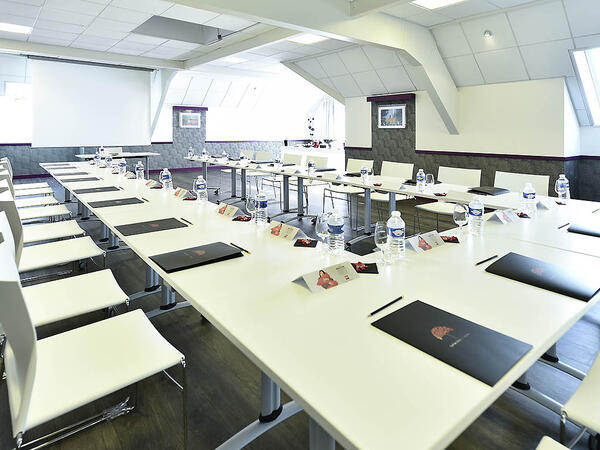
Located 200 meters far from the train station TGV, Swisslife Tower is today the most representative building of this quarter of Lyon. The Business Center offers you a perfect location for your training.
Gares TGV
100meters from Gare TGV Part-Dieu , porte du Rhône Exit
Aéroport
30 minutes from Lyon Saint Exupéry (Satolas)
Rhône Express from Saint Exupéry airport (Terminus Gare part-Dieu)
Modeling and Documentation for Business Analysis is a practical course focused on standard modeling languages and tools used to capture, visualize, and validate business requirements and processes.
This instructor-led, live training (online or onsite) is aimed at professionals with limited or no experience in modeling who wish to apply industry-standard techniques like UML, BPMN, and wireframing tools to improve clarity and communication in business analysis projects.
By the end of this training, participants will be able to:
Use UML diagrams to represent functional requirements and system behavior.
Model business processes using BPMN standards.
Create clear and structured use case diagrams and documentation.
Design wireframes and interactive prototypes using Figma and Balsamiq.
Format of the Course also allows for the evaluation of participants.
Interactive lecture and discussion.
Hands-on use of modeling tools in sample project scenarios.
Guided exercises focused on process, requirements, and UI modeling.
Course Customization Options
To request a customized training for this course based on your organization’s standards or preferred toolset, please contact us to arrange.
This instructor-led, live training in Lyon (online or onsite) is designed for programmers or anyone wishing to learn and utilize OCL and OWL to express various model query, manipulation, and specification requirements.
By the end of this training, participants will be able to:
Develop a better understanding of OCL and OWL architecture.
Utilize OCL and OWL to express model transformations.
Business analysis is the process of researching, understanding, and defining business needs to develop solutions that meet those needs. It is a key element in the process of managing change within an organization and designing new business solutions. Business analysis aims to ensure that technological, process, or organizational solutions align with business goals and requirements. It is crucial for ensuring the effectiveness of projects and changes within an organization by making sure that implemented solutions are accurate, feasible, and fully aligned with business needs.
This course is designed to teach the fundamentals of the Systems Modeling Language (SysML), its application via MagicDraw/Cameo software, basic Model-Based Systems Engineering (MBSE) simulation techniques, and best practices in MBSE.
The Business Process Model and Notation (BPMN), Decision Model and Notation (DMN), and Case Management Model and Notation (CMMN) are three Object Management Group (OMG) standards designed for process, decision, and case modeling. This course offers an introduction to all three, guiding learners on when to apply each standard effectively.
This instructor-led, live training in Lyon (online or onsite) is designed for individuals at beginner, intermediate, and advanced levels who wish to develop skills in business and process modeling to gain a better understanding of the organization, its products, and the dependencies between processes, data, and stakeholders.
By the end of this training, participants will be able to:
Understand the role of models as key communication tools in business analysis.
Select the appropriate modeling method (BPMN, UML, SIPOC, Business Model Canvas) for a specific business goal.
Decompose complex business processes into clear diagrams.
Identify touchpoints between processes, data, and system actors.
Assess the correctness and effectiveness of created business models.
This course will explain how to use SysML, the modelling language for systems engineering. You will specifically explore block diagrams for the structural modelling of complex systems. You will deepen your understanding of sequence diagrams, state diagrams, and activity diagrams for dynamic modelling. You will also learn how to use specific SysML diagrams such as the requirements diagram and the parametric diagram, as well as the concept of allocation. We will also emphasise the necessity of defining a modelling approach tailored to the organisational context and the type of system being studied. Practical exercises will be carried out using NoMagic's Cameo Systems Modeler (MagicDraw) modelling tool.
Audience:
Systems engineers, business analysts, and architects who need to model complex systems involving both hardware and software.
Teaching Method:
Theoretical presentation illustrated with examples
50% practical exercises with Cameo Systems Modeler on a case study throughout the course.
Numerous proven patterns are widely accessible. Often, the process involves adapting the nomenclature and implementing the pattern within a specific technology. This approach can save hundreds of hours that would otherwise be devoted to design and testing phases. Course Objectives This course has two primary objectives: first, to enable the reuse of well-established patterns, and second, to facilitate the creation and reuse of patterns tailored to your organization. It assists you in estimating how patterns can reduce costs, systematize the design process, and generate a code framework based on your patterns. Target Audience Software designers, business analysts, project managers, programmers, developers, as well as operational managers and software division managers. Course Approach The course focuses on use cases and their relationship with a specific pattern. Most of the examples are explained in UML and in simple Java examples (the language can change if the course is booked as a closed course). It guides you through the sources of the patterns as well as showing you how to catalogue and describe patterns which can be reused across your organization.
Through a blend of lectures, demonstrations, and interactive labs, this course demonstrates the foundational principles for creating and maintaining an Enterprise Architecture (EA) using the Unified Architecture Framework (UAF) version 1.2.
This course is designed to teach the fundamentals of the Systems Modeling Language (SysML), its application via the MagicDraw/Cameo software, basic Model-Based Systems Engineering (MBSE) simulation techniques, and MBSE best practices. The training covers the essentials of creating templates and generating reports within the MagicDraw/Cameo tool suite, and explains the functionality and application of macros and scripts within MagicDraw.
This course is designed to teach the fundamentals of the Systems Modeling Language (SysML), its application using MagicDraw/Cameo software, basic Model-Based Systems Engineering (MBSE) simulation techniques, and MBSE best practices. The training also aims to provide professionals with a background in architectural simulation, introduce the Simulation Toolkit plugin, cover the simulation of various diagram types, and demonstrate how to link diagram simulations to automate the architecture.
Designed to impart the fundamentals of the Systems Modeling Language (SysML), its practical application via MagicDraw/Cameo software, core MBSE simulation techniques, and industry best practices. This training covers essential concepts and features related to validation rules, validation suites, and model metrics, while introducing the core principles of developing and utilizing model queries in MagicDraw/Cameo.
This course is designed to teach the fundamentals of the Systems Modeling Language (SysML), its application via MagicDraw/Cameo software, basic Model-Based Systems Engineering (MBSE) simulation techniques, and MBSE best practices. The training provides an introductory overview of the core concepts and features of CATIA No Magic’s Teamwork Cloud, as well as the essential concepts and features of Domain Specific Languages (DSL) in MagicDraw.
NobleProg holds official OMG OCEB 2 Content Developer certification, meaning our course syllabi and training resources were crafted by the very experts who design the OCEB 2 exam questions.
This course is designed to prepare you for the OMG Certified Expert in BPM (OCEB v2) Fundamental Examination.
Upon completion, you can practice with our testing engine, which features over 200 sample questions.
The OCSMP Model Builder – Fundamental examination evaluates the knowledge and skills necessary to create a basic SysML model of a system. The exam covers model concepts and organization, basic requirements capture and management, structure and behavior models, parametric models, allocation relationships, and the use of stereotypes. With the knowledge and skills covered at this level, along with familiarity with a suitable SysML modeling tool, a holder of the OCSMP Model Builder – Fundamental Certification should be able to make productive contributions to modeling tasks performed by a Systems Engineering team employing a model-based systems engineering approach using SysML. The OCSMP Model Builder – Fundamental Certification is a prerequisite for the program’s two higher levels, and requires the OCSMP Model User Certification as its prerequisite.
This examination (as well as the others in the OCSMP series) tests your ability to apply the knowledge and skills listed here in the context of a model of a system. As you study, go beyond each individual diagram to understand how aspects that it models can influence or affect aspects of the system represented in other diagram types.
The OCSMP Model Builder – Intermediate certification validates the expertise and skills required to create system models utilizing the complete SysML feature set. This proficiency allows for more detailed and accurate modeling of requirements, structure, behavior, and parametric constraints compared to the Fundamental level. Furthermore, holders of this certification possess the understanding necessary to organize complex models, define relationships among model elements and diagrams, and evaluate model quality aspects, including compliance with language and method constraints. The knowledge level tested by this certification, combined with a corresponding level of expertise in model-based systems engineering methods and tools, is suitable for a System Modeling Lead for a project and for top-ranked team members who contribute independently to the model or to the system, such as a Lead Systems Engineer. The OCSMP Model Builder - Intermediate Certification is a prerequisite for the program's highest certification, OCSMP Model Builder – Advanced, and requires the OCSMP Model Builder – Fundamental certification as its prerequisite.
This course helps analysts and designers in the field of System Engineering understand how to efficiently gather requirements and proceed with embedded software design implementation based on system specifications, utilizing UML 2 and SysML.
Spanning three days, this training supports system analysts in expressing their needs effectively and enables designers to develop appropriate architectural designs based on those requirements.
The resulting system architecture enhances the agility of embedded system software in response to changes, ensuring coherent traceability between business rules embedded in system functions and end-user usage choices (use cases) down to the software implementation level.
This course is delivered in two variants to provide a practical understanding of how systems can be modelled using the latest version of the Object Management Group's (OMG) Systems Modelling Language (SysML) specification. The notation and underlying semantics of SysML are explained in a way that allows students to apply what they learn to any suitable system modelling method or tool.
This instructor-led, live training in Lyon (online or onsite) is designed for project managers, architects, and system engineers who wish to model and evaluate systems using SysML V2 features and capabilities.
By the end of this training, participants will be able to specify, analyze, design, and verify complex systems using SysML V2.
In this instructor-led, live training in Lyon (online or on-site), participants will learn how to leverage SysML as implemented in Enterprise Architect (EA) to perform system requirements analysis and modeling.
By the end of this training, participants will be able to:
Understand and apply SysML to Systems Engineering projects, adopting a Model Based Systems Engineering (MBSE) approach.
Identify system requirements derived from use case models.
This is a 3-day training covering principles of modeling, UML, SysML and use of MagicDraw or Cameo following a case study, which demonstrates a typical model-based systems engineering approach.
The course:
Includes lectures and hands-on practice in using MagicDraw or Cameo for systems modeling using SysML;
Explains major SysML concepts and diagrams;
Provides hands-on experience building system model examples;
Shows how to trace model elements in different views;
Explains how to use MagicDraw features efficiently;
Is based on a consistent modeling case study.
Audience:
System architects, system engineers, software architects and other stakeholders who will create and use models.
Methods:
Presentations, discussions, and case study-based practical assignments.
Course Materials:
Slides, case study model, and practical assignment descriptions.
Certificates:
Each participant receives NobleProg certificate indicating that he/she attended the training.
The "Object-oriented Analysis and Design using UML" course is aimed at analysts, designers, developers, testers, and project managers, offering an introduction to system modeling using UML. Through case study exploration, participants gain skills in modeling requirements, business processes, as well as documenting functional and non-functional requirements. Subsequent stages of the course cover the analytical model, design phases—both static and dynamic—and practical application of the Enterprise Architect modeling tool. The course provides a solid basis for effective process modeling in enterprises by leveraging UML throughout all stages of software development.
This course is tailored for analysts, designers, developers, testers, and project managers.
The workshop guides participants through problem analysis, system design, and documentation using UML and Sparx Systems' Enterprise Architect. Trainees will explore the software's advanced capabilities, such as MDA, profiles, and XMI, along with best practices that significantly simplify and accelerate the modeling process.
Since the training emphasizes the Enterprise Architect tool, participants are expected to already possess foundational UML modeling skills. For those wishing to learn modeling from scratch, we offer dedicated UML training.
The role of the IT Business Analyst is one of the most rapidly expanding positions within the IT industry. Business Analysts are integral to nearly every organization, serving as vital members of IT teams in both the private and public sectors.
This course offers a clear, step-by-step guide on how Business Analysts can effectively perform their roles using cutting-edge object-oriented technology.
NobleProg holds the official OMG OCUP 2 Content Developer designation, indicating that our curriculum and training resources are crafted by the same experts who author the OCUP 2 examination questions.
Audience
Developers, programmers, business analysts, project managers, software architects, testers, documentation specialists, and anyone engaged in the software development lifecycle.
Objectives
Equips you to work with the most frequently used UML elements Instructs you on constructing basic UML models Prepares you to join a UML Development Team
This course is designed for developers, programmers, business analysts, project managers, software architects, testers, documentation specialists, and anyone participating in the software development lifecycle.
Objectives:
Equips you to utilize a wide array of UML elements. Guides you on constructing complex UML models. Prepares you to qualify as a senior member of a UML Development Team.
Managers seeking to comprehend BPMN diagrams, Business Consultants, Business Analysts, Business Process Engineers, System Analysts, and all professionals engaged in analyzing and planning Business Processes through standardized, unified modeling notation.
Course Objectives:
Create high-quality process diagrams
Model processes using BPMN notation
Document existing ('as-is') process information
Implement optimized process flows for people-centric processes
Simplify complex process definitions by breaking them down into more manageable components
Read more...
Last Updated:
Testimonials (9)
Prepared project on which we could work from the start without wasting time to set up files not needed in exercises. Readiness to answer all questions that came up from participants.
Robert Walczak - Hitachi Energy
Course - Systems Modeling with SysML and Enterprise Architect (EA)
pointing about 'tricky' questions while explanation
The trainer shared his knowledge and led great atmosphere.
Agnieszka Dubanska - Narodowy Fundusz Zdrowia
Course - Modelowanie procesów biznesowych z wykorzystaniem UML i BPMN
complete, subject-focused, with multiple exercises and examples
Grzegorz Sposob - ASSECO POLAND S.A.
Course - OCUP2 UML Certification - Preparing for the UML2 Intermediate exam.
The explanations and interactivity of the trainer, he really brought the subject well; and even-though I was probably not experienced enough, I did learn a lot from it!
Pieter Bruynseels - Spot Buy Center BV
Course - Design Patterns
Labs and pace were great
Morgan - NSWCDD Dam Neck
Course - Applying SysML with MagicDraw/Cameo
- trainer's knowledge
- trainers laid-back style
Maciej - EY GLOBAL SERVICES (POLAND) SP Z O O
Course - OCEB2 OMG Certified Expert in BPM - BPM 2 Fundamental Exam Preparation
discover the potential of the tool
wassim - Collins Aerospace
Course - SysML par l'exemple avec Cameo Systems Modeler
Machine Translated
The direct correlation with our work subject in the examples
Online OMG training in Lyon, OMG training courses in Lyon, Weekend OMG courses in Lyon, Evening OMG training in Lyon, OMG instructor-led in Lyon, OMG coaching in Lyon, OMG instructor in Lyon, OMG one on one training in Lyon, Online OMG training in Lyon, OMG boot camp in Lyon, Weekend OMG training in Lyon, OMG on-site in Lyon, OMG trainer in Lyon, OMG classes in Lyon, OMG instructor-led in Lyon, Evening OMG courses in Lyon, OMG private courses in Lyon