AI for Robotics sits at the nexus of intelligence and movement, a space where algorithms reason, sensors interpret, and machines execute tasks with intention. This is the domain where raw data is converted into dexterity, driving the development of the next generation of autonomous systems, industrial robots, and intelligent devices.
These instructor-led live training programs enable participants to examine how artificial intelligence elevates robotics into adaptive, learning-based systems. Through practical exercises, learners engage deeply with perception models, motion planning, reinforcement learning, and AI-driven control frameworks that enhance machine responsiveness to approach human-like levels.
Online attendees are placed in an environment that replicates the rhythm of actual laboratories, receiving step-by-step guidance through live demonstrations and collaborative coding via an interactive remote desktop. Each session evolves as a collective inquiry into logic and movement, avoiding the passive nature of a standard lecture.
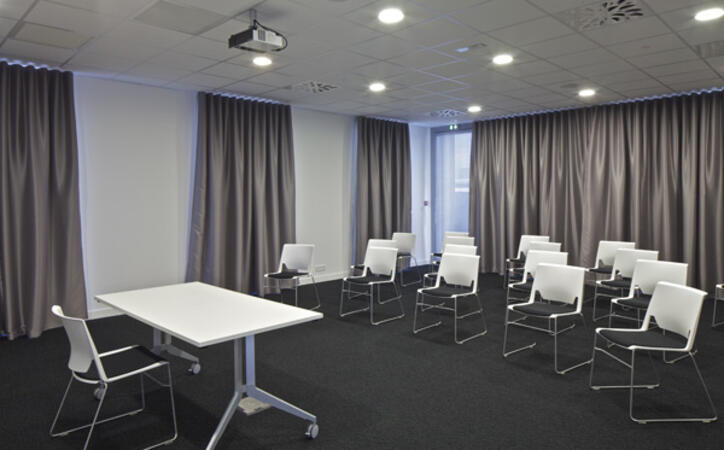
For teams preferring to develop and test collaboratively, onsite live training in Lille—delivered either at client facilities or NobleProg corporate centers—turns education into active experimentation. In this practical setting, robots, code, and creativity intersect, allowing theoretical concepts to take physical shape.
Also referred to as Robotics AI or Intelligent Robotics, our training supports professionals in connecting software with mechanics, creating systems that sense, decide, and act with growing autonomy and accuracy.
NobleProg — Your Local Training Provider
Lille, Gare Flandres
NobleProg Lille, 21 Avenue le Corbusier, Lille, france, 59800
In front of Flandres TGV Train Station
From Lille train stations
From Lille-Flandres: the address is essentially right next to the station — about 1–3 minutes on foot.
From Lille-Europe: walk toward Lille-Flandres along Avenue Le Corbusier. It is roughly 5–10 minutes on foot.
So you don't need a bus or metro if you're arriving by train.
If you're coming by bus
The nearest bus stops to Avenue Le Corbusier include Lion d'Or and Jacquet. Several local lines serve the area, including 13, 86, L5 and L91.
This practical, instructor-led training in Lille focuses on rapid prototyping for robotics utilizing ROS 2 and Docker. Participants will acquire the ability to efficiently build, test, and deploy modular robotic systems, developing hands-on expertise in containerization, simulation, and version control to support scalable development.
This practical HRI course in Lille focuses on voice, gesture, and collaborative control. It guides learners in building intuitive, multimodal interfaces for secure human-robot collaboration, emphasizing hands-on design principles, speech recognition, gesture detection, and shared autonomy to boost usability and safety.
This practical training in Lille focuses on ROS-PLC integration and digital twins within industrial automation. Participants will learn to synchronize robotic systems with PLCs, create digital replicas for simulation purposes, and enhance production workflows through real-time data exchange and sophisticated monitoring methods.
Advanced training in Lille focusing on deep learning for robotic manipulation. Gain expertise in perception, grasp planning, and control using neural networks and ROS 2. Practical simulation exercises equip you to effectively deploy intelligent, adaptable grasping solutions on real robotic arms.
A specialized training program on Lille that focuses on the architecture and synchronization of multi-robot systems. Learners acquire the skills to model swarm intelligence, execute distributed decision-making, and enhance inter-agent collaboration through practical simulation in ROS 2 and Gazebo, targeting real-world implementation.
This instructor-led live training in Lille guides advanced professionals through the process of integrating TinyML into autonomous robotics. Learners will design optimized models, construct on-device perception pipelines, and deploy lightweight AI on embedded hardware to achieve real-time autonomy.
This 21-hour instructor-led training in Lille delves into safety cases, verification, and explainable AI within robotics. Participants will learn to implement hazard analysis, ethical governance, and compliance standards to foster transparent and trustworthy robotic decision-making in real-world settings.
This live training in Lille assists intermediate engineers in deploying TinyML models for robotics. You will learn to optimize inference for speed and energy efficiency, integrate AI into control systems, and create autonomous, low-latency robotic solutions directly on embedded hardware.
This instructor-led, live training in Lille (online or onsite) is aimed at intermediate-level participants who wish to explore the role of collaborative robots (cobots) and other human-centric AI systems in modern workplaces.
By the end of this training, participants will be able to:
Understand the principles of Human-Centric Physical AI and its applications.
Explore the role of collaborative robots in enhancing workplace productivity.
Identify and address challenges in human-machine interactions.
Design workflows that optimize collaboration between humans and AI-driven systems.
Promote a culture of innovation and adaptability in AI-integrated workplaces.
This instructor-led live training in Lille explores the fundamentals of reinforcement learning and deep RL methodologies, including PPO and DDPG. Learners will build algorithms using Python and PyTorch, integrate them with ROS 2 and OpenAI Gym, and guide autonomous robots toward solving intricate tasks.
This instructor-led training on Lille focuses on applying computer vision to robotics through OpenCV and deep learning. Participants will master the implementation of perception pipelines, the integration of detection models, and the deployment of systems on embedded platforms for autonomous control.
This instructor-led, live training in Lille (online or onsite) targets advanced robotics engineers and AI researchers who wish to utilize Multimodal AI. The goal is to integrate various sensory data streams to create more autonomous and efficient robots capable of visual, auditory, and tactile interaction.
Upon completion, participants will be able to:
Implement multimodal sensing within robotic systems.
Develop AI algorithms for sensor fusion and decision-making.
Build robots capable of executing complex tasks in dynamic environments.
Address challenges related to real-time data processing and actuation.
In Lille, this live course provides advanced engineers with the AI competencies necessary for robotic perception, planning, and control. Participants will apply sensor fusion techniques, develop motion algorithms, and implement learning-based strategies to effectively integrate intelligent systems into smart manufacturing workflows.
This live, instructor-led training in Lille provides intermediate robotics engineers with practical proficiency in autonomous navigation and SLAM using ROS 2. Participants will learn to integrate LiDAR sensors, apply mapping algorithms, simulate scenarios in Gazebo, and deploy real-world navigation stacks on physical robots.
This live, instructor-led training in Lille (online or onsite) is designed for intermediate-level professionals aiming to elevate their capabilities in designing, programming, and deploying intelligent robotic systems for automation and beyond.
By the end of the course, participants will be able to:
Comprehend the principles of Physical AI and its role in robotics and automation.
Design and program intelligent robotic systems suited for dynamic environments.
Apply AI models to enable autonomous decision-making in robots.
Employ simulation tools for effective robotic testing and optimization.
Tackle key challenges such as sensor fusion, real-time processing, and energy efficiency.
This instructor-led live training on Lille explores the fundamental concepts and hands-on practices of AI for Robotics. It enables participants to develop practical skills that are directly applicable to real-world work environments and modern business requirements, utilizing ROS 2, TensorFlow, and OpenCV.
This live, instructor-led training in Lille guides developers through the process of constructing and deploying bots from the ground up. Learners will examine essential frameworks, design conversational logic, and implement sample chatbots for Facebook Messenger and the Microsoft Bot Framework.
This instructor-led live training in Lille (online or onsite) is designed for engineers interested in learning how to apply artificial intelligence to mechatronic systems.
Upon completing this training, participants will be able to:
Obtain a comprehensive overview of artificial intelligence, machine learning, and computational intelligence.
Grasp the core concepts of neural networks and various learning methodologies.
Select appropriate artificial intelligence approaches to address real-world challenges.
Deploy AI solutions within mechatronic engineering contexts.
Read more...
Last Updated:
Testimonials (2)
Supply of the materials (virtual machine) to get straight into the excersises, and the explanation of the Ros2 core. Why things work a certain way.
Arjan Bakema
Course - Autonomous Navigation & SLAM with ROS 2
its knowledge and utilization of AI for Robotics in the Future.
Ryle - PHILIPPINE MILITARY ACADEMY
Course - Artificial Intelligence (AI) for Robotics
Online AI for Robotics training in Lille, Robotics AI training courses in Lille, Weekend Robotics AI courses in Lille, Evening Robotics AI training in Lille, AI for Robotics instructor-led in Lille, AI for Robotics boot camp in Lille, Robotics AI private courses in Lille, Intelligent Robotics instructor in Lille, Weekend Intelligent Robotics training in Lille, Robotics AI classes in Lille, Robotics AI trainer in Lille, Evening Robotics AI courses in Lille, Intelligent Robotics coaching in Lille, Online Robotics AI training in Lille, AI for Robotics one on one training in Lille, AI for Robotics on-site in Lille, Intelligent Robotics instructor-led in Lille